
Our 66 is an average of all our schools
The state's Student Achievement score for our district is a 66. Here's where that number actually comes from, and what it can and can't tell you about your own kid.
When the state's grades came out, we saw a D, and a lot of us felt our stomach drop. I did too. My kids are in these schools. So I went and figured out where those numbers actually come from.
The state grades our schools on three things: how kids are scoring, how much they're growing, and how the kids with the furthest to go are doing. This is about the first one. It's called Student Achievement, and for our district it's a 66. That 66 is an average of all our schools. Every Del Valle school has its own Student Achievement number, and the district's is all of them put together, our bigger schools counting for more because they teach more kids. So every school is part of it, and when any one of them gets stronger, the 66 rises with it.
Take Del Valle High as an example. The state looks at three things there: how its students did on their tests, how many graduate, and how many leave ready for college, a career, or the military. It scores each one, weighs them together, and Del Valle High comes out at a 72. Every school gets its number the same way. For our elementary and middle schools, it's mostly the tests, since they don't have graduates yet. Line all our schools up, weight them by size, and the average is that 66.
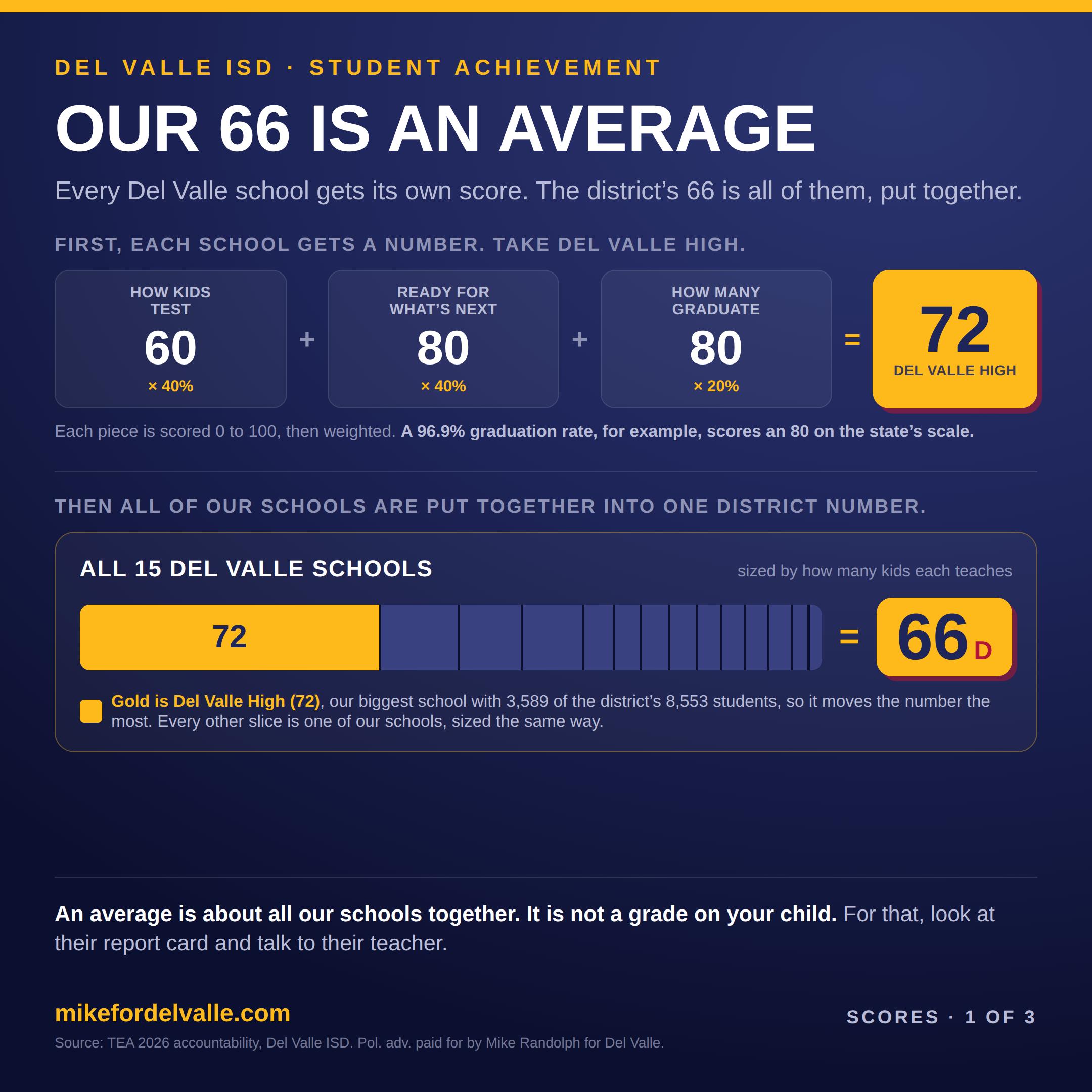
Here's the part I want every parent to hear. An average is about a group, never about one child. Our 66 tells you something real about the district as a whole. What it can't tell you is how your own child is doing, or where they're headed. For that, look at their report card, their own test results, and a talk with their teacher. Those tell you your kid's real story, far more than a district number ever could.
So that's the 66: all of our schools, averaged into one number. What it can't show is whether our kids are moving forward from where they started. That's the next piece I'll walk through.
Pol. adv. paid for by Mike Randolph for Del Valle.
Get the next one in your inbox
No spam and no daily blast, just the breakdowns as the race goes on.